- Enterprise Modernization
- Platform UX Architecture
- Interaction Design
- Business-Rule Definition
- Design-to-Delivery Leadership
Modernizing a Complex Enterprise Platform
Client Central was a large B2B platform used by financial institutions to manage debit and credit card programs across roughly 84 applications, including card management, transaction research, fraud investigation, administration, and reporting. Two decades of additions had left workflows inconsistent, navigation fragmented, and critical product rules embedded in the live software rather than documented.
As the platform’s sole UX designer, I led the research, workflow mapping, interaction design, accessibility requirements, and business-rule documentation for its modernization. I redesigned roughly 60 applications and created the prototypes, reusable standards, annotated specifications, and backlog-ready direction that product, engineering, and QA used to release the work incrementally over about four years.
Role: Senior UX Designer; sole designer on the platform
Scale: Enterprise platform spanning approximately 84 applications and more than 30 user roles
Methods: Customer and stakeholder interviews, heuristic evaluation, workflow analysis, usability testing, information architecture, and interaction design
Delivered: Clickable prototypes, reusable UX standards, business rules, annotated specifications, and backlog-ready epics, stories, and features
Outcome: Approximately 60 applications released through an incremental rollout over about four years
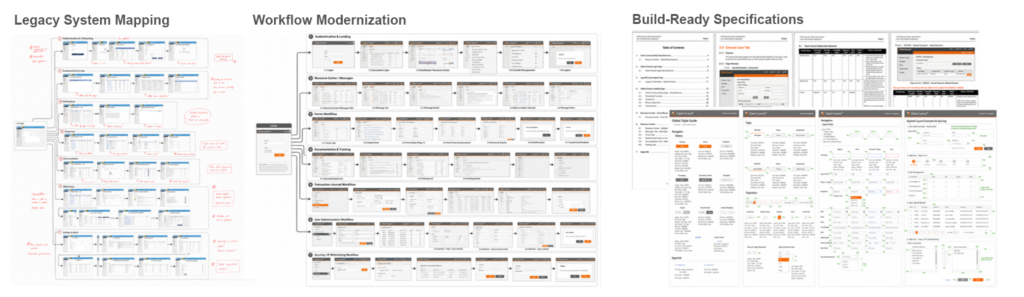
Owning the Modernization
Client Central was not a single interface that could be visually refreshed. It was a network of roughly 84 applications supporting different institutions, roles, permissions, and security-sensitive workflows. The challenge was to simplify how people navigated and completed work without removing the operational logic customers still depended on.
I was the sole UX designer on the platform. The product manager was new to the system and relied on me to define the research direction, reconstruct undocumented rules, prioritize high-risk workflows, and provide engineering with detailed interaction and validation logic. The PM retained backlog ownership; I translated the redesign into epics, stories, and features and worked directly with engineering under delegated authority.
I connected user needs, product behavior, accessibility requirements, security constraints, and implementation details into one modernization path. This was product-design ownership at platform scale: understanding the system before changing it, deciding what to preserve or consolidate, and making each redesign buildable.
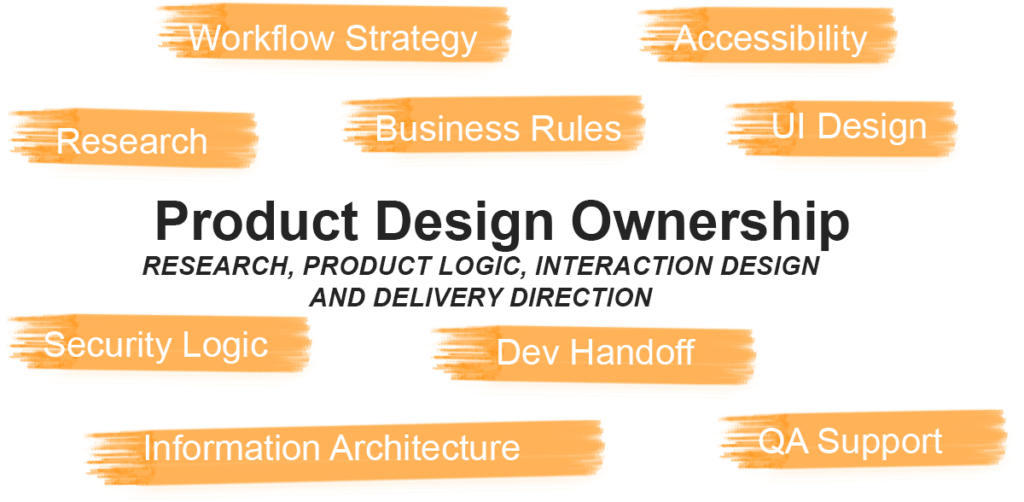
Redesigning the Legacy System
Before redesigning screens, I mapped how Client Central actually worked: where users entered, how workflows branched, which tasks caused confusion, and where legacy behavior created avoidable friction. Interviews, stakeholder input, heuristic evaluation, workflow analysis, and business-rule review revealed recurring problems across the platform—unclear navigation, dense tables, inconsistent forms, permission-sensitive actions, and critical logic that was difficult to discover.
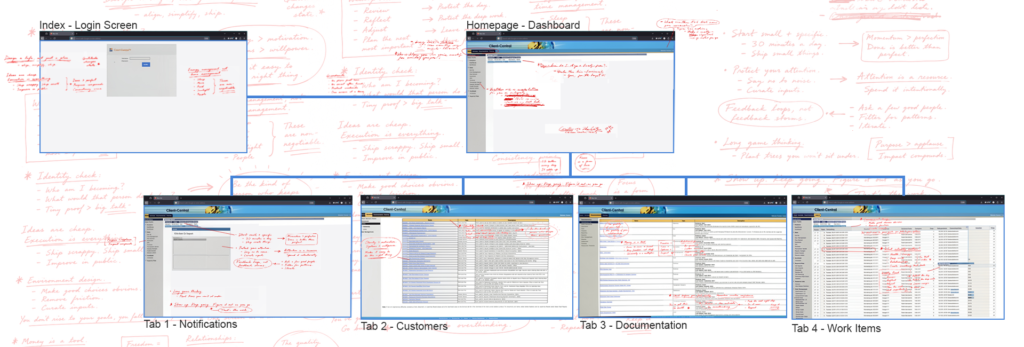
The larger risk was undocumented behavior. Two decades of rules lived in the production environment and in the knowledge of long-time users, so I worked through the live platform field by field to reconstruct states, permissions, validations, and dependencies before deciding what to preserve, consolidate, or change.
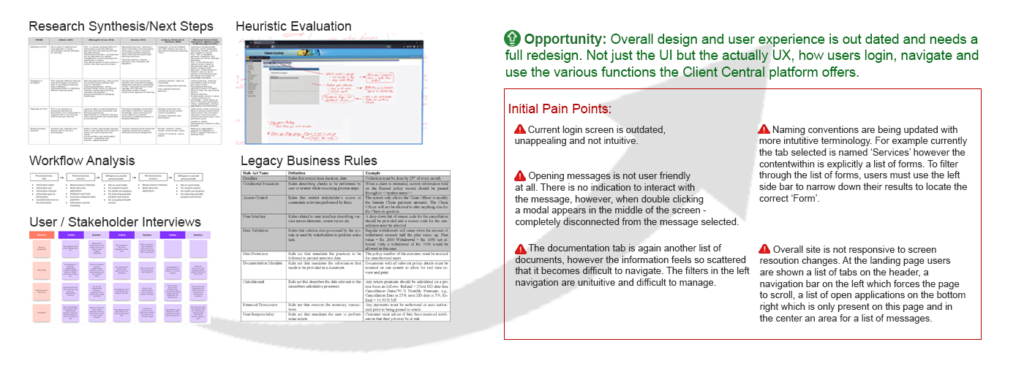
Research synthesis combined interviews, workflow analysis, heuristic findings, and reconstructed business rules.
Early evaluation showing systemic navigation, terminology, discoverability, and information-architecture problems.
That evidence shifted the work from a screen refresh to platform modernization:
1. Audit live workflows — map tasks, dependencies, and current behavior.
2. Prioritize structural risk — focus on high-use, high-friction, and security-sensitive work.
3. Define reusable product logic — standardize information architecture, interaction patterns, fields, states, permissions, and validation.
4. Convert decisions into delivery direction — create prototypes, specifications, and backlog-ready work.
This gave product, design, engineering, and QA a consistent path from diagnosis through release without removing the operational logic customers depended on.
Redesigning Core Workflows
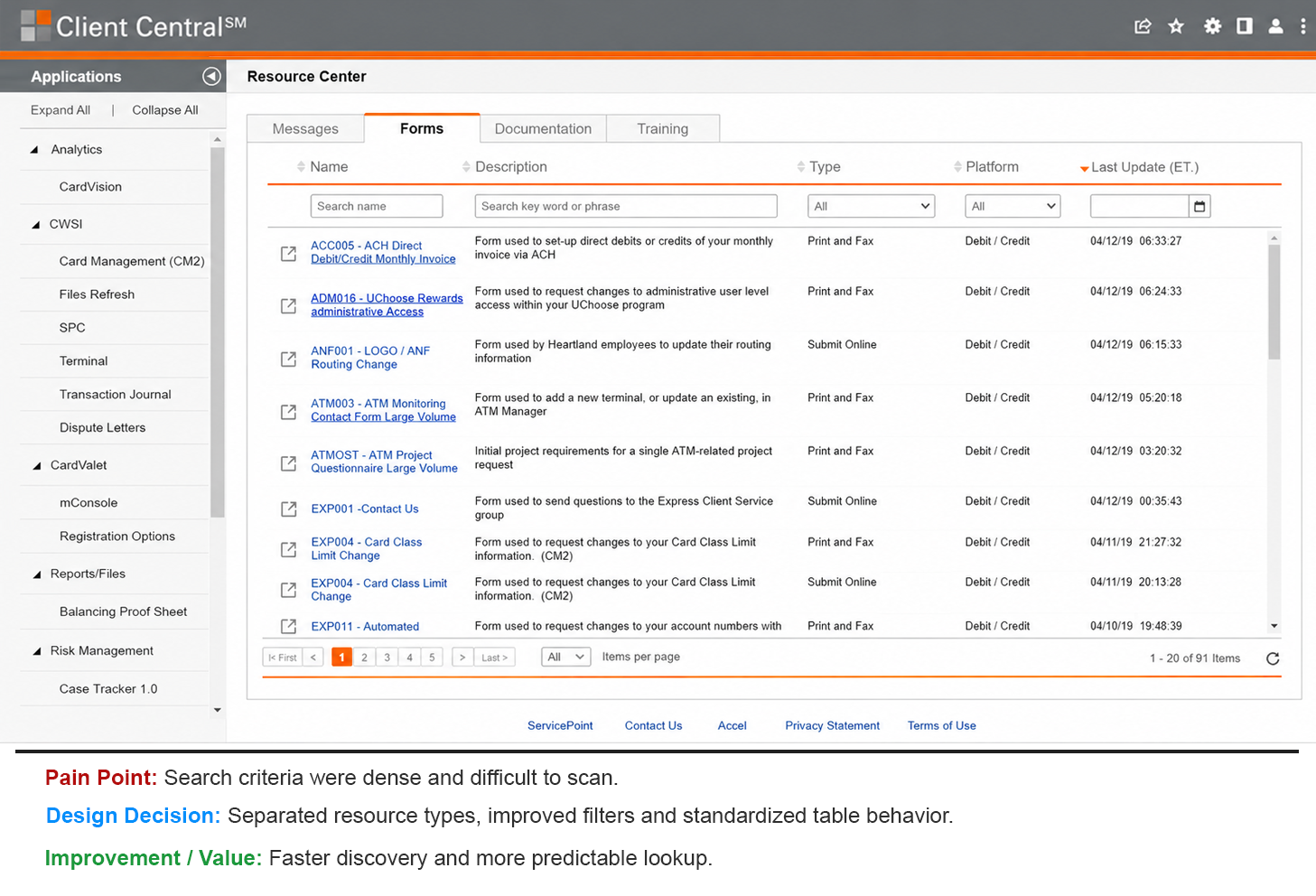
The system map helped me identify the workflows where structural improvement would reduce the most risk: finding resources, completing searches, preventing data loss, validating required inputs, and managing users and permissions.
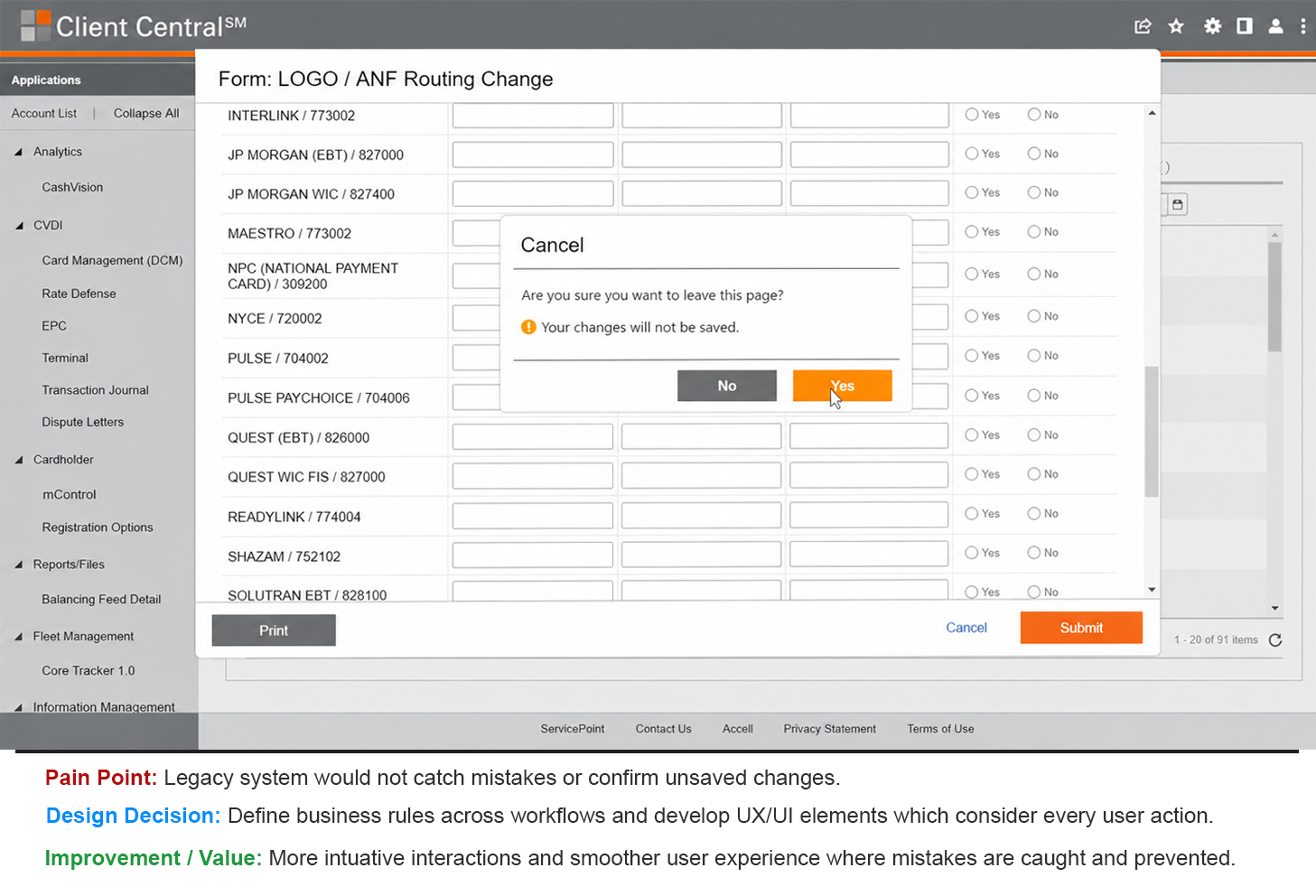
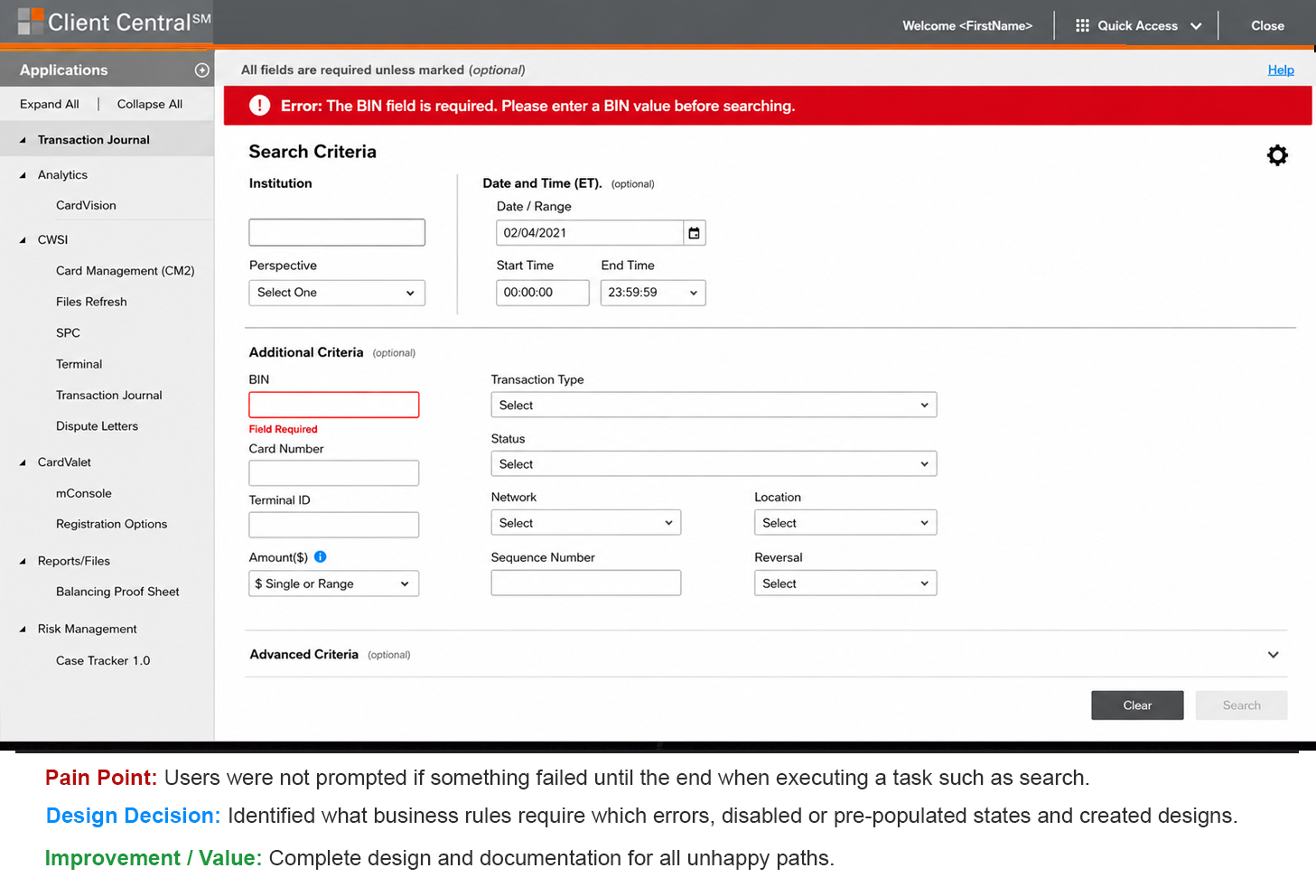
Across these workflows, I redesigned navigation, page hierarchy, forms, table behavior, filtering, validation, action placement, disabled states, confirmation behavior, and permission-aware interactions. Rather than treating each application as a separate interface, I established patterns and rules that could be reused across the platform.
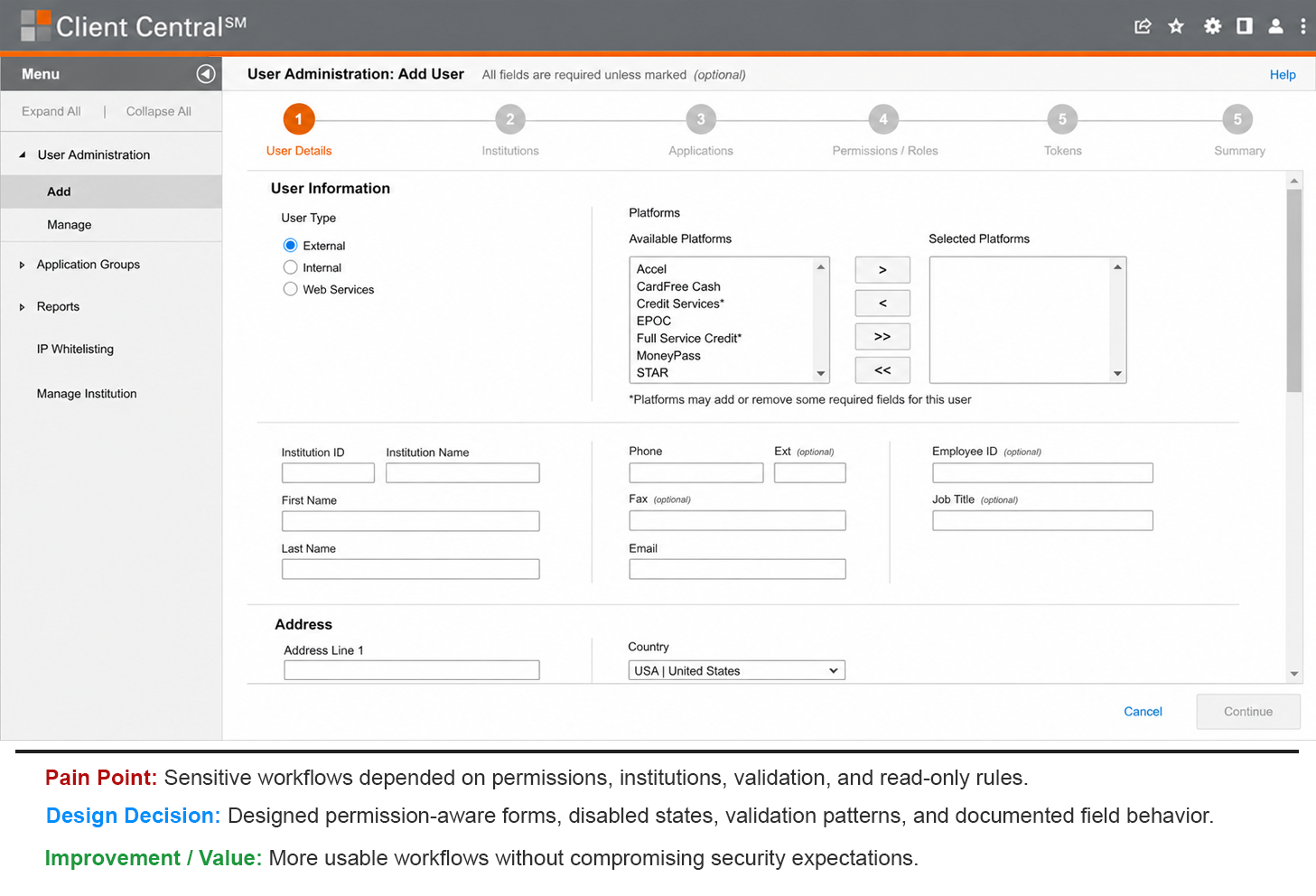
The workflow map below shows the broader redesign. The four hotspots highlight representative decisions involving search, administration, validation, and unsaved-change protection.
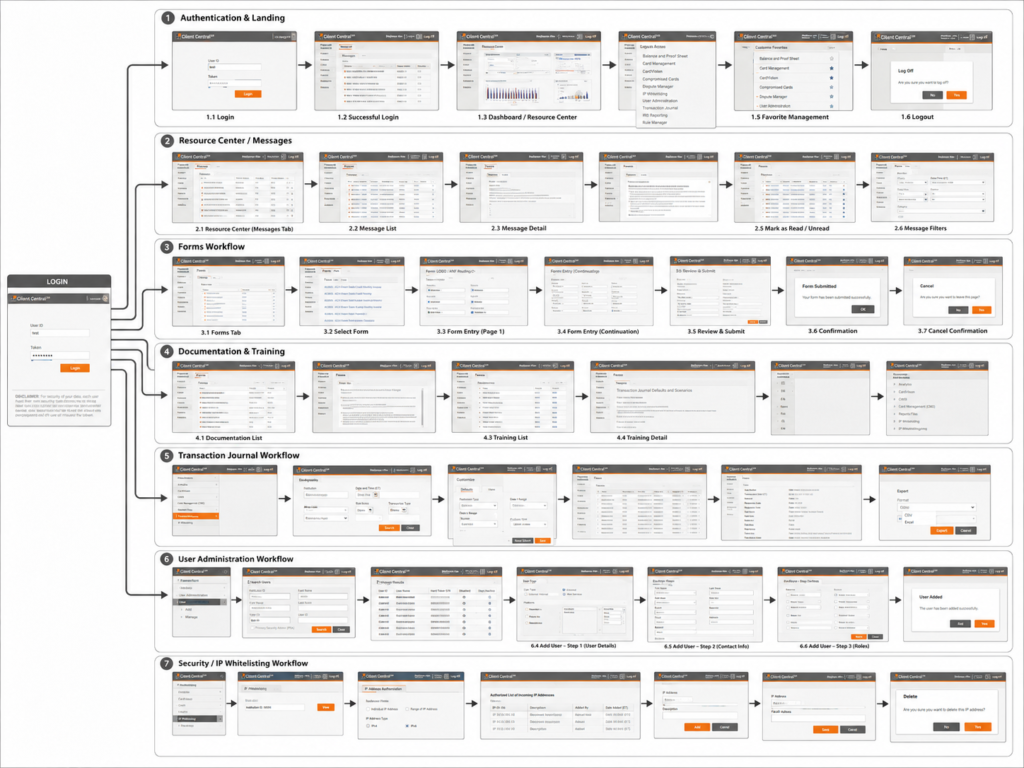
Representative workflows from the production redesign; hotspots show interaction rules reused across multiple applications.
User Administration
Add User was the most complex workflow, so I used it to establish the platform’s reusable logic. Institution and platform selection determined which fields became required; user type controlled available permissions and roles; and multi-step validation prevented incomplete or unauthorized configurations. Once defined, those rules and components accelerated the redesign of simpler workflows.
Making the Redesign Buildable
Because Client Central operated in financial services, every redesign had to preserve security, permissions, accessibility, validation, and institution-specific behavior. The work could not stop at wireframes.
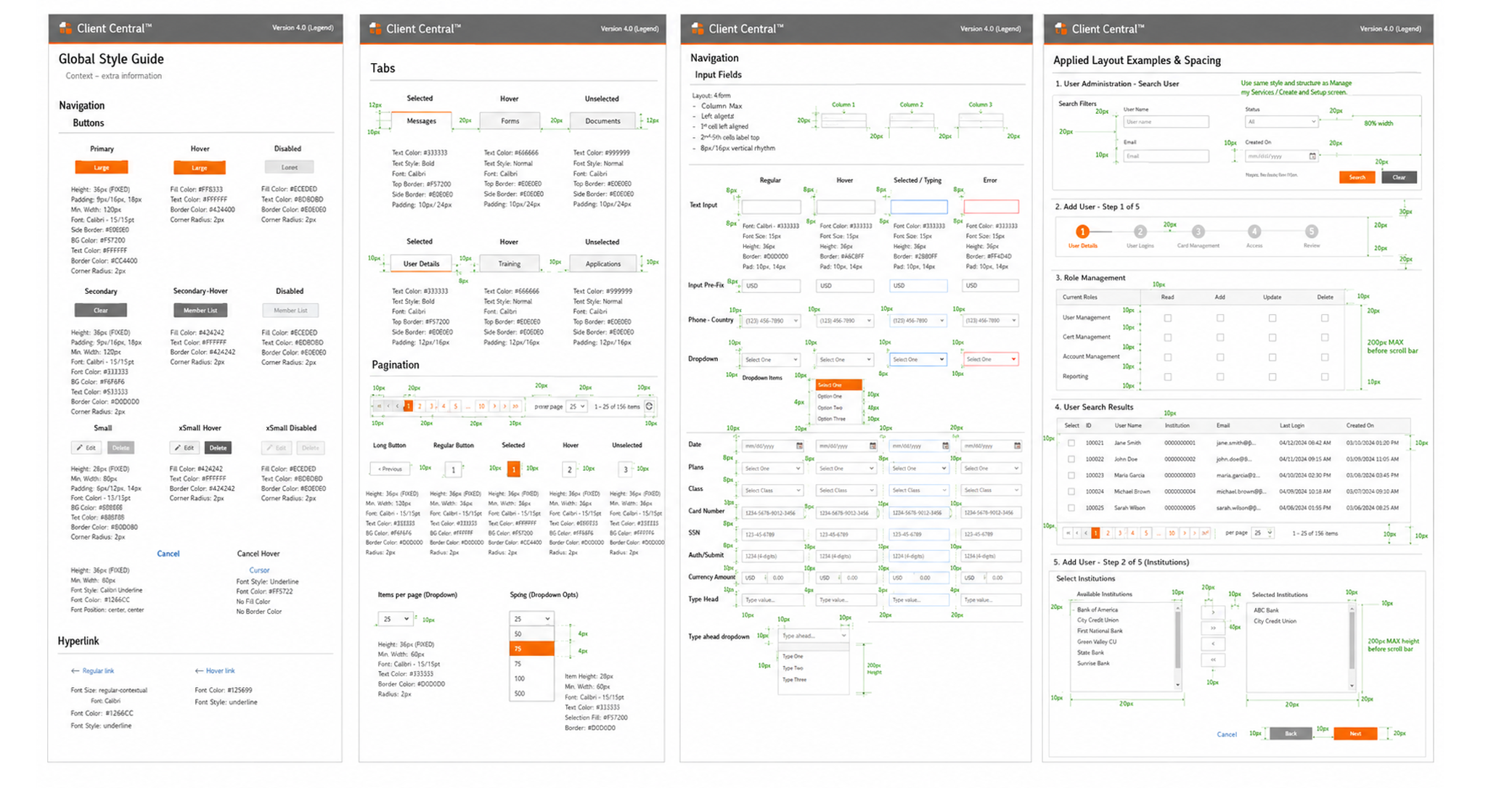
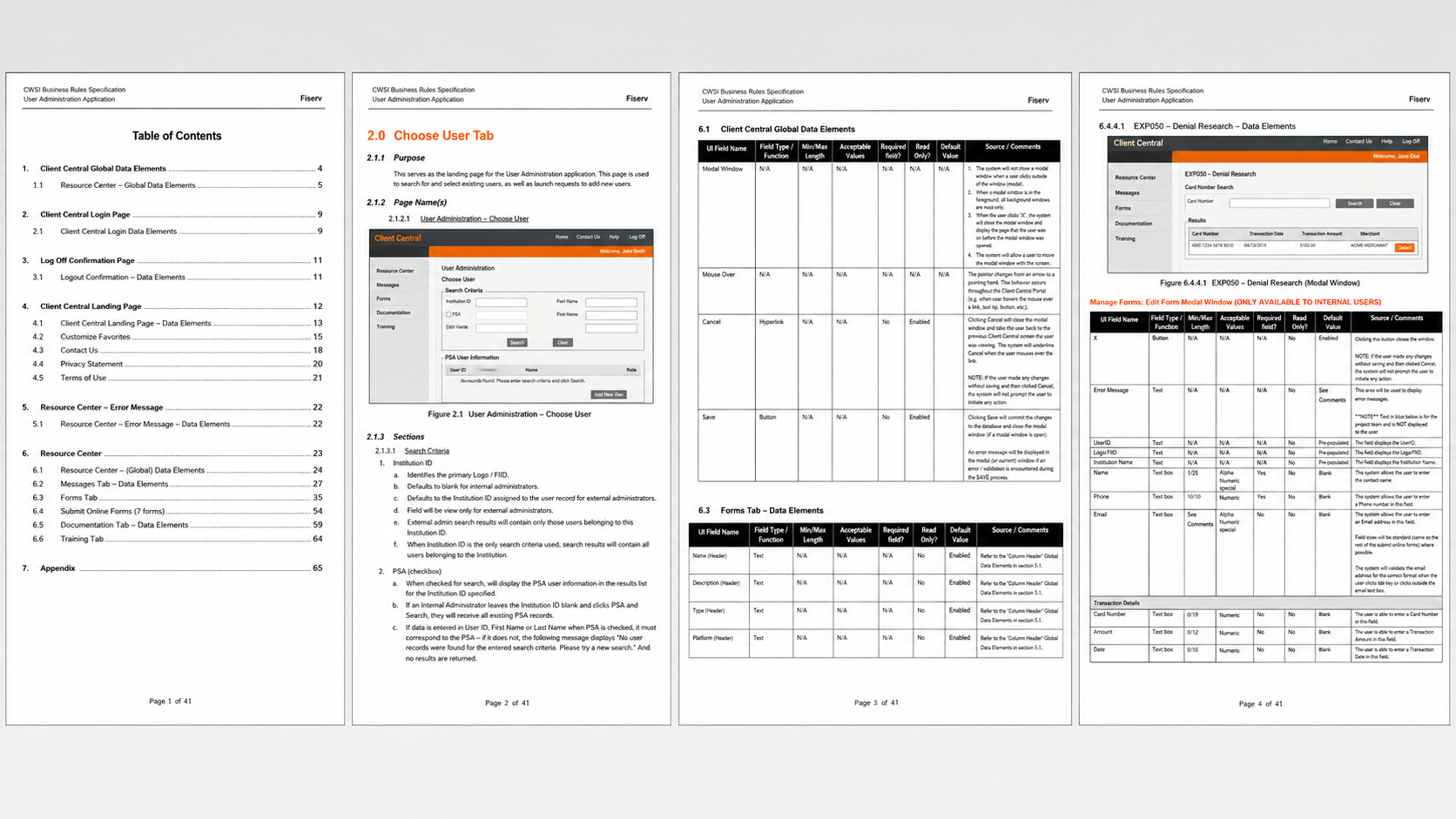
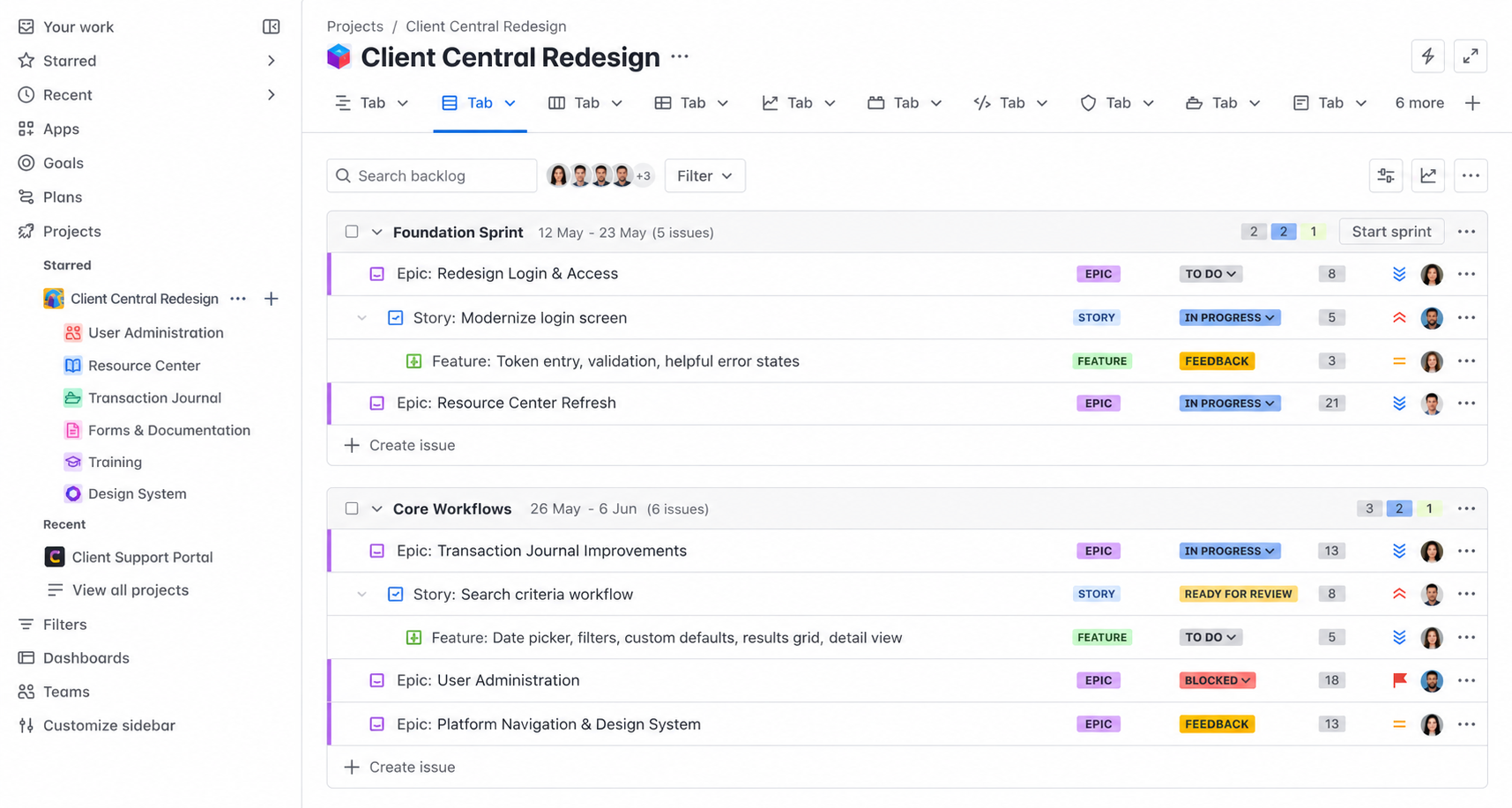
I created the delivery materials engineering, QA, and product used to build and test the redesign: an Axure clickable prototype, a reusable UX standards guide, a business-rules document with field- and state-level annotations, narrated screen-by-screen walkthroughs, and backlog-ready epics, stories, and features.
These artifacts became the reference across design, product, engineering, QA, and implementation. They reduced interpretation during delivery and allowed the redesign to continue consistently across applications and release cycles.
What Shipped
The modernization established a clearer, more consistent platform foundation that supported ongoing production releases.
Production Delivery
Roughly 60 of the platform’s approximately 84 applications were redesigned and released incrementally over about four years. I continued working against the live product throughout the rollout, refining patterns as new applications, dependencies, and edge cases emerged.
Adoption
The redesigned workflows and reusable standards became the baseline for new work. Long-time users and customers responded positively in surveys and feedback, while stakeholders used the updated patterns across subsequent releases.
What This Enabled
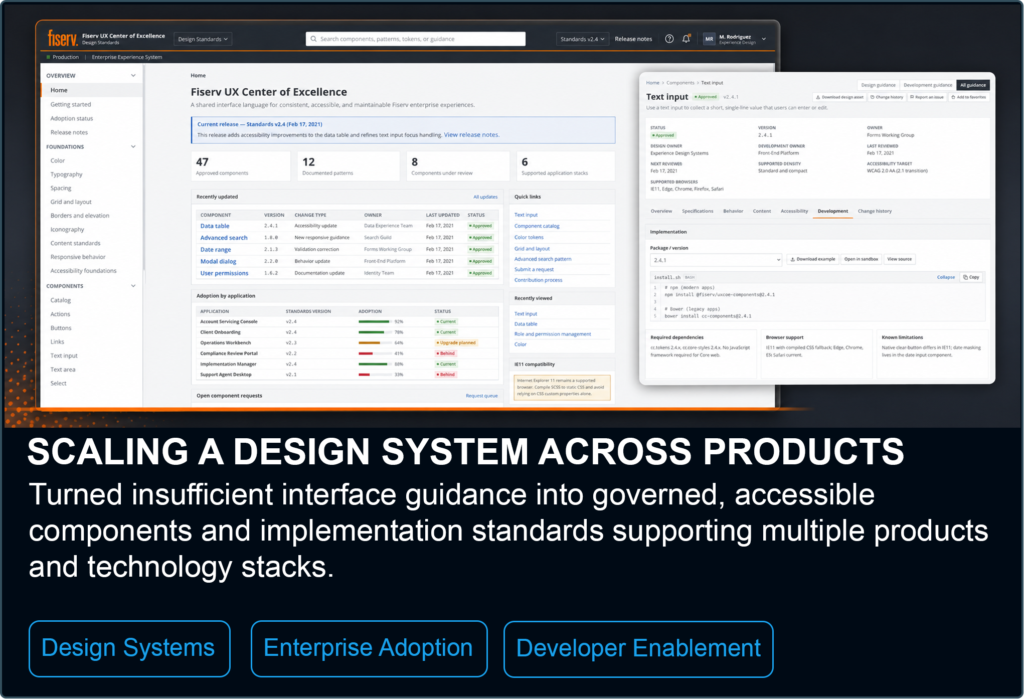
The project also exposed limitations in Fiserv’s existing reusable patterns. That evidence helped establish the need for the separate enterprise design-language initiative shown elsewhere in the portfolio.
Modules Mapped
Documented the platform ecosystem and recurring workflow logic before redesigning individual screens.
Modules Released
Redesigned and supported production rollout across the majority of the platform including the core dashboard experience.
User Roles Considered
Accounted for differences in institutions, platforms, permissions, and task responsibilities.
Years of Incremental Rollout
Refined reusable patterns and delivery guidance against real implementation over multiple release cycles.
Design Leadership Takeaway
This project demonstrates how I lead enterprise product modernization: reconstruct the system and its hidden rules, establish reusable interaction logic, and translate that logic into artifacts engineering and QA can execute.
System Before Screens
I mapped roughly 84 modules, more than 30 user roles, and two decades of accumulated business rules while changing individual interfaces.
Design Through Delivery
I remained involved through engineering reviews, build sign-off, narrated walkthroughs, and QA support so implementation matched the intended product behavior.
Constraints as Design Inputs
I simplified workflows while preserving institution-specific behavior, permissions, security, accessibility requirements, and operational dependencies.
Common Questions
The product manager was new to the platform, so I led the research, reconstructed the business rules, translated the redesign into epics, stories, and features, and worked directly with engineering under delegated authority. The PM retained backlog ownership, while I handled much of the product definition and delivery direction.
I considered workflow frequency, user friction, business risk, technical dependency, and the potential to establish reusable patterns. Add User came first because it touched institutions, platform selection, permissions, validation, and multiple states; solving it established rules and components that could then be reused in simpler workflows.
I traced behavior directly in the production system, compared it with the knowledge of long-time users and stakeholders, and documented fields, states, permissions, validations, and dependencies. Those interpretations were then reviewed through recurring product, engineering, QA, and subject-matter-expert discussions before release.
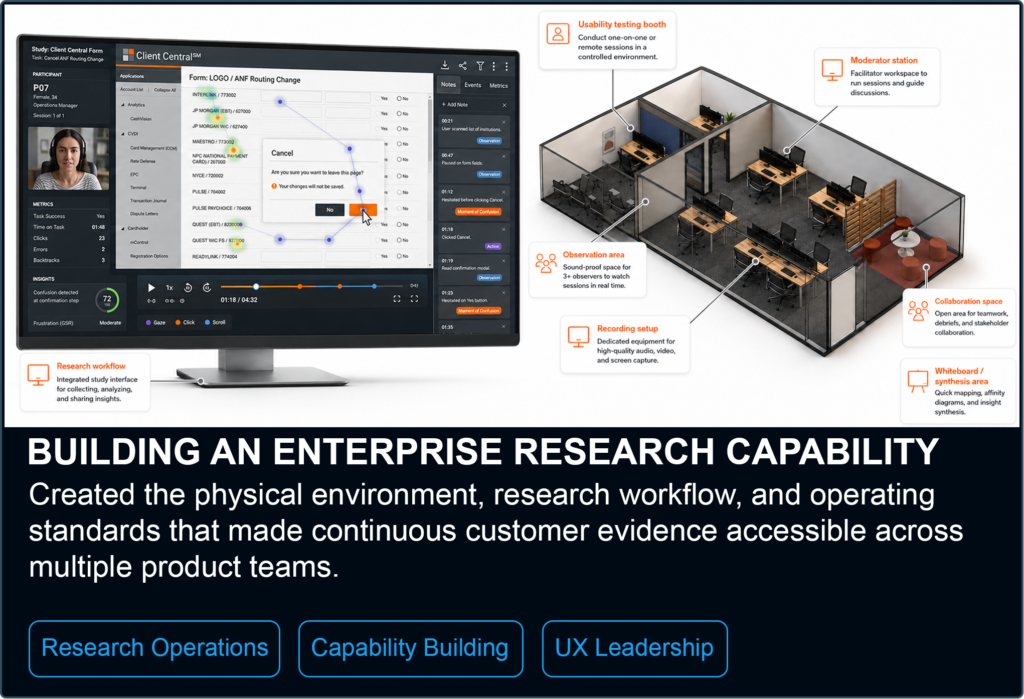
Stakeholder and leadership reviews occurred every few weeks, customer interviews occurred roughly every six months, and later usability testing was conducted through the research lab I established. This allowed the work to be reviewed throughout delivery and tested more formally as the organization’s research capability matured.
Roughly 60 of approximately 84 applications were released over about four years, the redesigned patterns became the baseline for new work, and long-time users and customers responded positively through surveys and feedback. The project also exposed design-language limitations that led to a separate enterprise initiative.
Related Fiserv Work
Client Central became the product foundation for two broader Fiserv initiatives. The need for repeatable validation led to the UX Usability Lab, while recurring inconsistencies across product patterns led to the enterprise Design Language Overhaul.
Specific product details, stakeholder names, and implementation details are confidential. This case study focuses on the UX/UI design approach, artifact types, and strategic value of the work.
RECOMMENDED NEXT CASE STUDIES →
Continue from complex product delivery into scalable standards and actionable research strategy.
© 2026 Harsh Kumar. Some project details have been generalized or redacted to protect confidential information.